EXCERPT
ONE
Monday
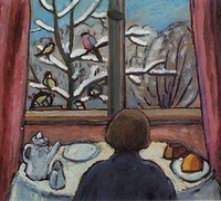
The birds are in their trees,
the toast is in the toaster,
and the poets are at their windows.
They are at their windows
in every section of the tangerine of earth -
the Chinese poets looking up at the moon,
the American poets gazing out
at the pink and blue ribbons of sunrise.
The clerks are at their desks,
the miners are down in their mines,
and the poets are looking out their windows
maybe with a cigarette, a cup of tea,
and maybe a flannel shirt or bathrobe is involved.
The proofreaders are playing the ping-pong
game of proofreading,
glancing back and forth from page to page,
the chefs are dicing celery and potatoes,
and the poets are at their windows
because it is their job for which
they are paid nothing every Friday afternoon.
Which window it hardly seems to matter
though many have a favorite,
for there is always something to see-
a bird grasping a thin branch,
the headlights of a taxi rounding a corner,
those two boys in wool caps angling across the street.
The fishermen bob in their boats,
the linemen climb their round poles,
the barbers wait by their mirrors and chairs,
and the poets continue to stare
at the cracked birdbath or a limb
knocked down by the wind.
By now, it should go without saying
that what the oven is to the baker
and the berry-stained blouse to the dry cleaner,
so the window is to the poet.
Just think -
before the invention of the window,
the poets would have had to put on a jacket
and a winter hat to go outside
or remain indoors with only a wall to stare at.
And when I say a wall,
I do not mean a wall with striped wallpaper
and a sketch of a cow in a frame.
I mean a cold wall of fieldstones,
the wall of the medieval sonnet,
the original woman's heart of stone,
the stone caught in the throat of her poet-lover.
Statues in the Park
I thought of you today
when I stopped before an equestrian statue
in the middle of a public square,
you who had once instructed me
in the code of these noble poses.
A horse rearing up with two legs raised,
you told me, meant the rider had died in battle.
If only one leg was lifted,
the man had elsewhere succumbed to his wounds;
and if four legs were touching the ground,
as they were in this case -
bronze hooves affixed to a stone base -
it meant that the man on the horse,
this one staring intently
over the closed movie theater across the street,
had died of a cause other than war.
In the shadow of the statue,
I wondered about the others
who had simply walked through life
without a horse, a saddle, or a sword -
pedestrians who could no longer
place one foot in front of the other.
I pictured statues of the sickly
recumbent on their cold stone beds,
the suicides toeing the marble edge,
statues of accident victims covering their eyes,
the murdered covering their wounds,
the drowned silently treading the air.
And there was I,
up on a rosy-gray block of granite
near a cluster of shade trees in the local park,
my name and dates pressed into a plaque,
down on my knees, eyes lifted,
praying to the passing clouds,
forever begging for just one more day.
Traveling Alone
At the hotel coffee shop that morning,
the waitress was wearing a pink uniform
with "Florence" written in script over her heart.
And the man who checked my bag
had a nameplate that said "Ben."
Behind him was a long row of royal palms.
On the plane, two women poured drinks
from a cart they rolled down the narrow aisle-
"Debbie" and "Lynn" according to their winged tags.
And such was my company
as I arced from coast to coast,
and so I seldom spoke, and then only
of the coffee, the bag, the tiny bottles of vodka.
I said little more than "Thank you"
and "Can you take this from me, please?"
Yet I began to sense that all of them
were ready to open up,
to get to know me better, perhaps begin a friendship.
Florence looked irritated
as she shuffled from table to table,
but was she just hiding her need
to know about my early years -
the ball I would toss and catch in my hands,
the times I hid behind my mother's dress?
And was I so wrong in seeing in Ben's eyes
a glimmer of interest in my theories
and habits-my view of the Enlightenment,
my love of cards, the hours I tended to keep?
And what about Debbie and Lynn?
Did they not look eager to ask about my writing process,
my way of composing in the morning
by a window, which I would have admitted
if they had just had the courage to ask.
And strangely enough - I would have continued
as they stopped pouring drinks
and the other passengers turned to listen -
the only emotion I ever feel, Debbie and Lynn,
is what the beaver must feel,
as he bears each stick to his hidden construction,
which creates the tranquil pond
and gives the mallards somewhere to paddle,
the pair of swans a place to conceal their young.
House
I lie in a bedroom of a house
that was built in 1862, we were told -
the two windows still facing east
into the bright daily reveille of the sun.
The early birds are chirping,
and I think of those who have slept here before,
the family we bought the house from -
the five Critchlows -
and the engineer they told us about
who lived here alone before them,
the one who built onto the back
of the house a large glassy room with wood beams.
I have an old photograph of the house
in black and white, a few small trees,
and a curved dirt driveway,
but I do not know who lived here then.
So I go back to the Civil War
and to the farmer who built the house
and the rough stone walls
that encompass the house and run up into the woods,
he who mounted his thin wife in this room,
while the war raged to the south,
with the strength of a dairyman
or with the tenderness of a dairyman
or with both, alternating back and forth
so as to give his wife much pleasure
and to call down a son to earth
to take over the cows and the farm
when he no longer had the strength
after all the days and nights of toil and prayer -
the sun breaking over the same horizon
into these same windows,
lighting the same bed-space where I lie
having nothing to farm, and no son,
the dead farmer and his dead wife for company,
feeling better and worse by turns.
In the Moment
It was a day in June, all lawn and sky,
the kind that gives you no choice
but to unbutton your shirt
and sit outside in a rough wooden chair.
And if a glass of ice tea and a volume
of seventeenth-century poetry
with a dark blue cover are available,
then the picture can hardly be improved.
I remember a fly kept landing on my wrist,
and two black butterflies
with white and red wing-dots
bobbed around my head in the bright air.
I could feel the day offering itself to me,
and I wanted nothing more
than to be in the moment - but which moment?
Not that one, or that one, or that one,
or any of those that were scuttling by
seemed perfectly right for me.
Plus, I was too knotted up with questions
about the past and his tall, evasive sister, the future.
What churchyard held the bones of George Herbert?
Why did John Donne's wife die so young?
And more pressingly,
what could we serve the vegetarian twins
who were coming to dinner that evening?
Who knew that they would bring their own grapes?
And why was the driver of that pickup
flying down the road toward the lone railroad track?
And so the priceless moments of the day
were squandered one by one -
or more likely a thousand at a time -
with quandary and pointless interrogation.
(continued on next page)
...a single short poem
has room for history,
music, psychology,
religious thought,
mood, occult speculation, character, and events
of one's own life.
~ Robert Bly